
Yield only holds if the exit is as disciplined as the entry. Rates, liquidity, and collateral health were already part of how Zyfai watches a position. Glider Monitor adds an outside detection layer, built for protocols, and plugs it into the same execution path that moves funds.
Our 80+ pools are now monitored by Glider Monitor, built by Hexens.
What was already watching
Multiple checks were already running before Glider Monitor.
Price. Stablecoin collateral is watched against its peg, at tight thresholds. In the Resolv incident a 15 bp move was enough to warn, and the positions left the affected pool. That case is written up here.
FUD alerts. An LLM watches public chatter and alerts the team when fear builds around a collateral or a protocol.
Collateral status. Each collateral is classified against the risk framework. The result is public on the risk dashboard.
TVL stability. A pool passes when its TVL is no more than 20% below its high of the last 14 days. A deeper drop means money has already left.
APY and TVL together. A high yield on its own is allowed. The pool fails only when the APY is more than 2 standard deviations above its mean and the TVL is more than 20% below its 14-day high at the same time. That is a yield spike while the pool is emptying.
Curator allocations. Moves in where a curator places the vault’s funds are watched, so a shift into a new market shows up as its own signal.
Why
DeFi positions can be at risk long before a protocol reports or even acknowledges an incident. An attacker may target a contract holding your funds, or an exploit elsewhere may reveal the same vulnerability in a protocol you use. A vault, market, or collateral token can also start failing safety checks before anyone has confirmed an attack.
Glider Monitor by Hexens covers those three cases. Zyfai treats a serious alert as a change in what a strategy is allowed to hold.
1. Direct attack. Glider Monitor watches live transactions against the addresses we integrate. If it concludes one of them is an attack, it raises a critical alert immediately, even when that vector has never shown up in a public exploit feed. This applies to every integrated address.
2. 0-day. When an exploit is disclosed on a supported chain, Glider Monitor reconstructs what the attack actually abused, turns that into a query, and runs it against verified contracts. A match is a hit. A miss is recorded as a clear. That pass typically takes 10-15 minutes from disclosure.
3. Custom invariants. On top of the automatic checks, we authored rules for the protocols and the collateral behind the strategies. They are re-checked on every state change. A break opens as a high or critical alert.
Custom invariants. On top of the automatic checks, we wrote rules on the collateral tokens behind the strategies.
Pause, critical. The token is paused and transfers are frozen. Funds in it cannot move until it unpauses, so this alert stops new money from going in.
Admin change, warning. The owner or minter changed. Someone new can mint or upgrade the token. Issuers rotate these keys in normal operation, so this warns the team and the price check is the second signal.
Supply spike, warning. On the smaller tokens, supply jumps more than 5% above the low of the last day. That is a mint, visible before the peg moves.
When Glider Monitor raises an alert, Zyfai still checks the resulting transaction against its existing rules for approved protocols, actions and parameters. The alert does not grant permission to move funds to an unapproved address.
For example, the USR incident was a mint. The token left its peg, and that price was how we knew. Glider Monitor, from Hexens, watches the 80+ pools your funds sit in, and the contracts under them, at the moment something changes. A mint that shows up in supply, before the peg moves, is one example of what the agent can now see.
How it is wired
Glider Monitor sends a signed webhook to Zyfai's data backend. The signature is verified before the payload is trusted.
For a direct attack or a 0-day, the affected pool is marked not live in that same request. The status change is emitted immediately to the execution backend. From there the exit is a normal rebalance: out of the flagged pool, into an approved venue the strategy is still allowed to use, or withdrawn to idle until a better opportunity shows up. Either way, the funds leave.
What we measured
We tested the path with a signed direct-attack payload against the Clearstar cbAssets Vault on Base. It was a controlled drill on a live position, small on purpose. The route is the one used at real size.
Step | Time |
|---|---|
Data backend receives the alert | 2026-09-23 16:29:20.147 |
Execution backend has it | 2026-09-23 16:29:20.227 |
Rebalance confirmed on Base | 2026-09-23 16:29:57 |
In this test, it took 80ms for our API to pass the Glider Monitor alert to the execution backend. The transaction moving funds out of the vault was confirmed on Base 37 seconds after our API received the alert. We aim to reduce the response time further.
The rules on the collateral
The 80+ pools are not watched as a single balance. Each one sits on markets, vaults, and ERC-20 collateral, and the invariants are written for that logic. Every rule below is passing.
Vault takeover, before it completes. On MetaMorpho vaults, owner, guardian, timelock, and fee have to stay unchanged over a trailing 24 hours. Those are the levers a takeover actually moves. A second rule fires earlier: a timelock reduction that has been submitted but not yet executed. Shortening the timelock shrinks the time a guardian has to react, and the reduction is itself timelocked, so the alert is the moment it is queued.
Morpho Blue accounting. Borrowed assets must stay less than or equal to supplied assets on each market. Separately, the supply exchange rate is only supposed to rise as interest accrues. A drop of more than 0.5% from the 24-hour peak is the earliest onchain signature of bad debt being socialized onto suppliers.
The peg the oracle is assuming. Morpho positions stay collateralized only if the oracle is honest. For USD-pegged assets those markets depend on, a Chainlink feed moving more than 1% off $1 is the early signal of a liquidation cascade. A wider rule fires when a stablecoin deviates more than 10% from its peg, the class of event behind the USDC depeg in 2023.
Aave, minted claims versus the index. An aToken's total supply has to equal its scaled supply multiplied by the reserve's live liquidity index. On a healthy Aave V3 reserve that identity holds, down to a rounding unit. If it breaks, the token’s accounting has come apart from the reserve. The same family covers the rest of the Aave surface we use, on Ethereum and on Base: supply and borrow caps not exceeded, liquidation bonus still safe, and interest indexes that must never fall below where they started.
Fluid is in the same set. Its liquidity-layer exchange prices are accumulators that only move up, and utilization on a token must stay at or under 100%. A reading through either floor means the accounting itself is wrong.
The map underneath
The map shows the contracts Zyfai uses and their dependencies, including the status of default and custom monitoring checks. Squares at the top are monitored vaults. Red nodes mark collateral contracts whose critical checks are passing, while grey nodes have no checks of their own.
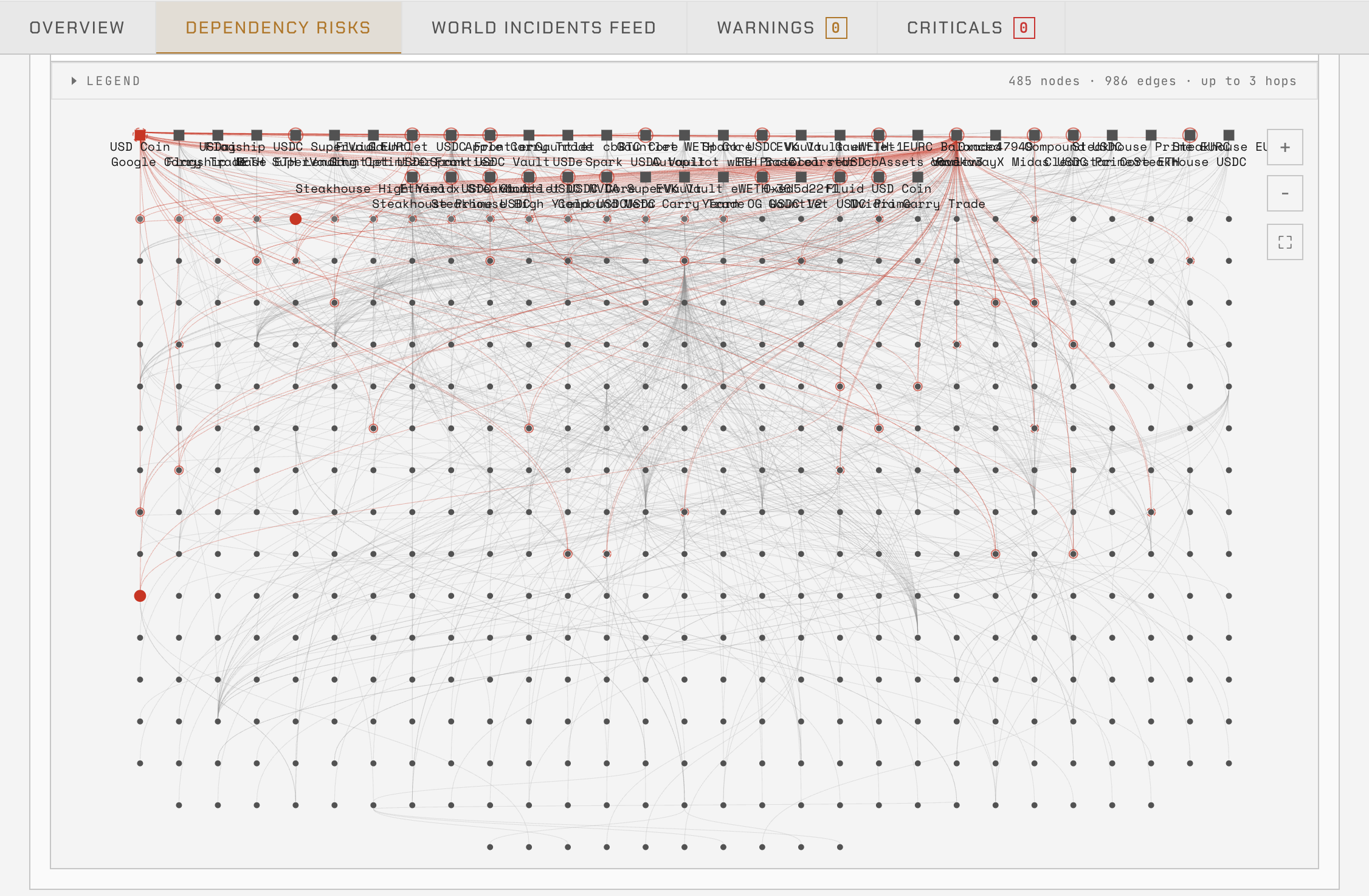
This snapshot includes 622 contracts and 1,137 connections, with dependencies traced up to three levels deep. It helps us identify which pools could be affected by a problem in an underlying contract.
Color is the contract itself. Red means a critical rule is on that contract and it is passing. Deep red would mean a critical rule is failing. Orange and yellow are the same split at lower severity. Grey means nothing is evaluated on that node. In this view the vaults and the Aave collateral row are red. Nothing on the map is in failure.
A ring is what it depends on. A red ring means the contract stands on critical coverage, and that coverage is holding. An empty ring means nothing monitored sits anywhere below it. A line is the worst thing you reach by following it. Solid is direct. Dashed is further down the chain. A failure below outranks a clean check below, so a problem cannot hide behind a healthy parent.
Shape is role. Squares are the contracts we monitor, the roots of the graph: the vaults along the top, from USD Coin and Gauntlet to Clearstar cbAssets. Circles are dependencies. Size is how much the node matters, from its own rules, to its ring, to how connected it is.
The grey field under the red row is the point of the picture. Coverage is explicit. You can see which collateral is checked, and where the watch stops.
What this changes for users
The protocols behind the yield stay the same: Aave, Compound, Morpho, Spark, Euler, Fluid, and the rest of the approved set. What changes is the layer in front of them.
A live attack on an integrated address, a new exploit that matches a verified contract, or an invariant breaking on a vault, a market, or a collateral token is no longer something noticed after the fact. Direct-attack, custom invariants and 0-day alerts already pull the position out. The funds leave the pool, into another approved venue or into idle, until the strategy has somewhere safe to go.
Users keep automated yield. The monitoring that protects it runs on the 80+ pools and on the contracts underneath them, and the exit is already plugged in.
About Zyfai
Zyfai gives you self-custodial access to autonomous low-risk DeFi. Our customizable rule-based Agents transform your idle capital into productive assets, rebalancing between curated opportunities.
The result is sustainable and risk-adjusted yield, where your capital is always working and under your control.