

In July, Zyfai Agents continued to outperform static vaults, while the first full month of weekly fee collection generated nearly four times June's fees and delivered an 8.3% APY in USDC to $ZFI stakers.
This monthly report covers Zyfai's performance in July:
How much Yield Agents generated for users
How Zyfai performed against static pools
How much protocol revenue was collected
How much USDC yield was distributed to $ZFI stakers
What shipped this month
What comes next
1. Agent Yield Performance
July 1–July 31, 2026
Average Zyfai Agent APY (without incentives): 6.41%
Average Static Pool APY: 4.52%
Net Yield Outperformance: +41.65% vs. static DeFi
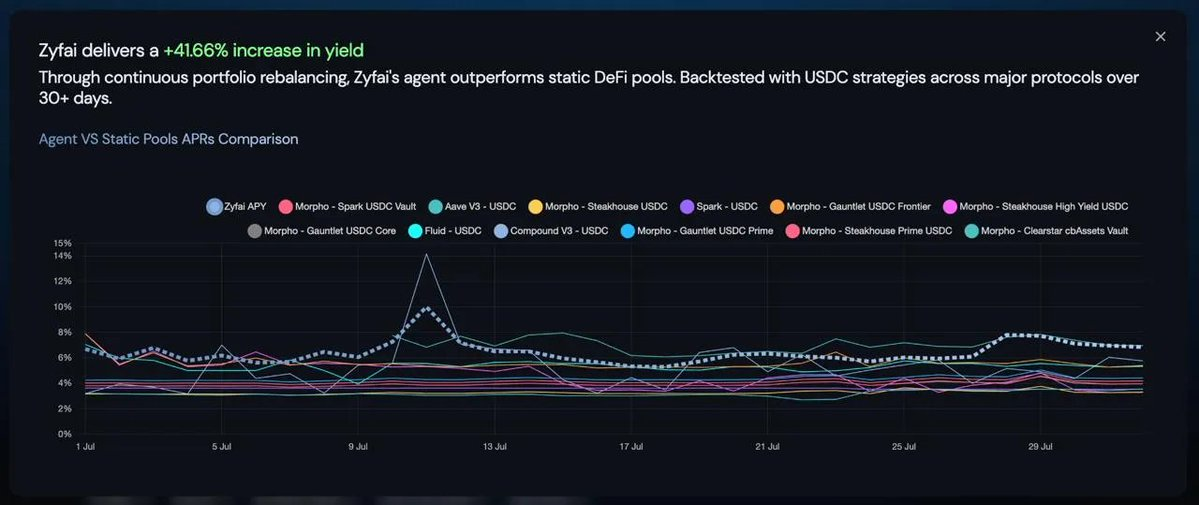
In July, Zyfai Agents once again delivered stronger yields than static vaults.
For every $100 of yield generated by a static strategy in July, Zyfai Agents generated $141.65.
The logic is straightforward. Static strategies allocate capital once and leave it there. Zyfai's rule-based Agents continuously evaluate yield, liquidity, and pool risk, then rebalance when a stronger risk-adjusted opportunity becomes available.
Capital preservation remains the priority behind every allocation. Before Agents can access a pool, it must first pass the quant team's whitelisting process. From there, the risk layer monitors pool health, liquidity, collateral conditions, TVL and APY stability, and FUD on socials around the clock.
2. Yield Performance by Wallet Size
The figures below compare weighted APYs by wallet-size cohort, measured net of fees and including rZFI incentives where applicable.
$1K–$10K Wallets
Average APY (with rZFI): 10.3148%
Average APY (native, no rZFI): 8.0154%
Example Wallet Link
$10K–$100K Wallets
Average APY (with rZFI): 10.0964%
Average APY (native, no rZFI): 7.7971%
Example Wallet Link
$100K+ Wallets
Average APY (with rZFI): 8.5425%
Average APY (native, no rZFI): 6.2432%
Example Wallet Link
Smaller wallets benefited most from rapid capital rotation and the higher relative APYs available through more aggressive strategies. Larger wallets prioritized liquidity depth and safer strategies, since even modest rebalancing gains could make a meaningful difference at the portfolio level.
3. Protocol Metrics: July Snapshot
Total AUM: ~$8.09M
USDC AUM: ~$5.88M
ETH AUM: ~733 ETH
WBTC AUM: ~1.88 WBTC
cbBTC AUM: ~11.34 cbBTC
Agents deployed: 15,559
Agentic volume: ~$3.11B
Cumulative rebalancing transactions: ~233K+

By chain:
Ethereum:
AUM: ~$433K USDC + 1.51 WBTC + 145 ETH
Agents deployed: 610
Rebalancing transactions: 1,802
Average APY with incentives: 8.44% on USDC, 2.62% on WBTC, 4.38% on WETH

Base:
AUM: ~$4.75M USDC + 11.34 cbBTC + 519 ETH
Agents deployed: 5,850
Rebalancing transactions: 158,176
Average APY with incentives: 11.48% on USDC, 5.87% on cbBTC, 7.83% on WETH

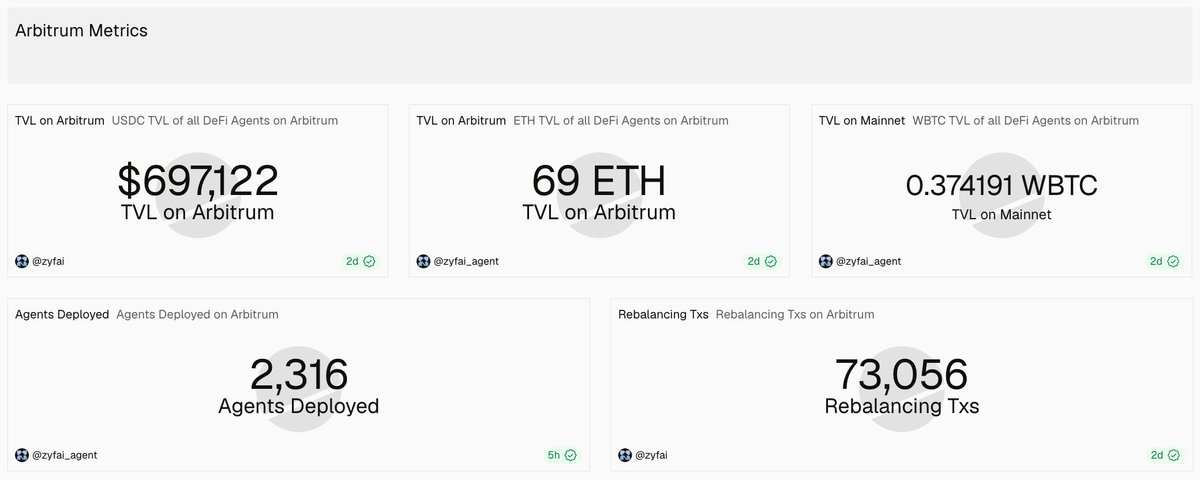
Arbitrum:
AUM: ~$697K USDC + 0.37 WBTC + 69 ETH
Agents deployed: 2,316
Rebalancing transactions: 73,056
Average APY with incentives: 7.48% on USDC, 2.36% on WBTC, 3.17% on WETH
4. Protocol Fees and $ZFI Staking Yield
Zyfai takes a 10% performance fee on yield generated by Agents. This fee is charged only on profit, never on deposited capital.
The same Agent activity that earns users their yield is what funds the staking stream, so stakers hold a direct claim on protocol performance rather than token emissions.
Every fee collected runs through the DAO treasury first, then splits in two:
50% to $ZFI stakers, paid in USDC and distributed monthly on a pro-rata basis
50% to protocol operations and R&D under the DAO mandate
Updated Fee Collection Model: $9,919 in July Fees
July was the first full month of Zyfai's weekly performance fee collection model.
The mechanism generated $9,919 in USDC fees across supported chains, compared with $2,586 in June.
That was 3.84x June's total, showing that the weekly collection model worked as intended and turned ongoing Agent performance into a more consistent revenue stream.
July Report
Snapshot date: July 31, 2026
Stakers: 2,350
$ZFI staked: 88,114,143 (17.65% of total supply)
Performance fees accrued: $9,919 USDC
$ZFI price at snapshot: $0.0056
Staking amount at snapshot in $ value: $493,439
50% streaming to $ZFI stakers = $4,960 or 8.3% APY
50% allocated to protocol operations and development under the DAO mandate = $4,960
How to maximize your monthly staking yield
If you want the highest share of rewards, timing matters.
The earlier in the month you stake, the larger your position at snapshot time.
Snapshot happens at the end of every calendar month.
If you staked in Month A, you receive yield throughout Month B.
If you unstake before the end-of-month snapshot, you are excluded from the next month's reward stream.

5. What Shipped in July
July was a strong month for AUM growth, but that wasn't the only highlight.
Zyfai also:
Introduced theYield Simulator Playground for allocation previews before deposits
Added Fluid USDC vaults on Base and Arbitrum
Added the ClearstarLabs cbAssets Vault to Zyfai strategies
Launched a new Merkl incentive campaign for USDC, WETH, and cbBTC on Base
Started rZFI Phase 5, running through January 9, 2027
Announced the upcoming Morpho Midnight integration for automated fixed-term lending
Crossed $3B in agentic volume
Ranked highest overall in the new Trust & Security Framework for Agentic DeFi, developed by Owney.
6. What's Next
The main priorities for August are:
Improve the product experience across onboarding, deposits, and strategy selection
Launch more partnerships and integrations
Introduce more ways to generate yield across new assets
The August focus is practical: make the product easier to use, ship entirely new features, and continue showing the market why onchain SMAs are a better way to allocate capital.
TL;DR: July 2026
Agent Performance:
Average Zyfai Agent APY: 6.41%
Average Static Pool APY: 4.52%
Net Yield Outperformance: +41.65% vs. static DeFi
Protocol Fees and Staker Yield:
Protocol Fees Collected: $9,919
USDC Distributed to $ZFI Stakers: $4,960
Native Staking APY: 8.3%
About Zyfai
Zyfai gives you self-custodial access to autonomous low-risk DeFi. Our customizable rule-based Agents transform your idle capital into productive assets, rebalancing between curated opportunities.
The result is sustainable and risk-adjusted yield, where your capital is always working and under your control.